
Success Story

From classroom prototype to clinical research
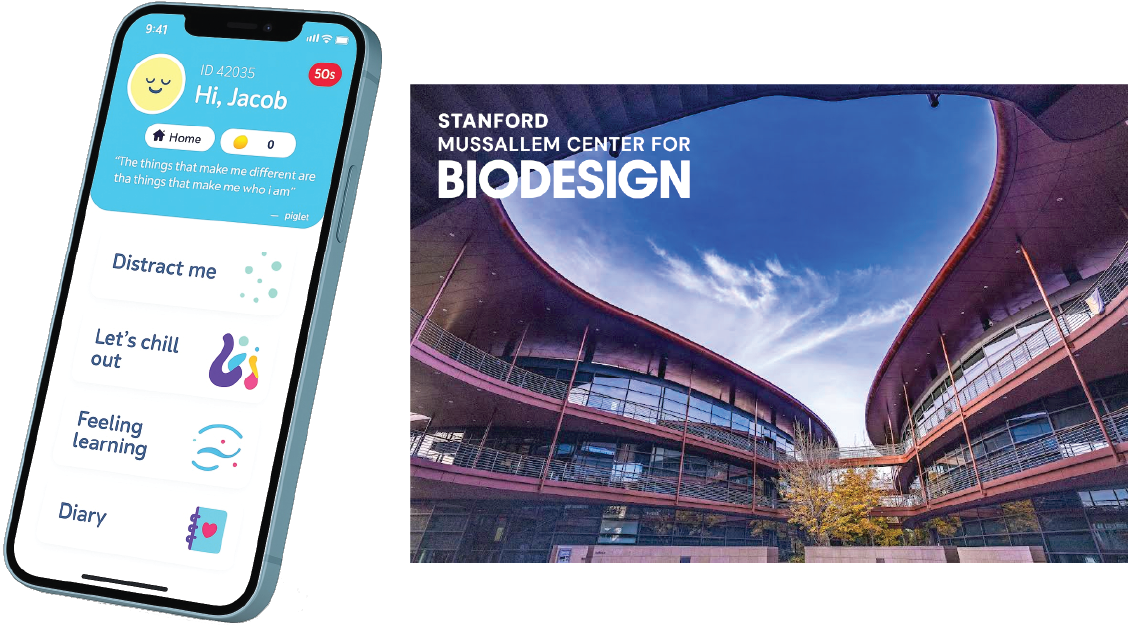

Stanford Biodesign
Digital therapeutic, adolescent eating disorders · Stanford, CA
- class project to clinical-ready
- 3 monthsclass project to clinical-ready
- running in a closed Stanford Clinic trial
- 18+ monthsrunning in a closed Stanford Clinic trial
- real-time heart-rate monitoring
- Watch + HealthKitreal-time heart-rate monitoring
The Situation
Stanford's CS 342 - Building for Digital Health course brings together Stanford Computer Science and Stanford Medicine to turn clinical ideas into working digital-health products.
For one of these projects, Stanford's Department of Psychiatry and Behavioral Sciences was developing Balance, an application led by Dr. James Lock to support adolescents with eating disorders. The goal was to help participants manage distress and emotional regulation during difficult moments such as mealtimes, while also giving the research team better visibility into their experience.
Students had already created an initial prototype using Stanford's Spezi framework, but moving from a course project to software that could be used by real participants in a clinical research setting required a different level of engineering, reliability, integration, and product maturity.
The Solution
We took the student-built prototype and evolved it into a native iOS digital-health application suitable for use by real study participants and Stanford researchers.
Balance gives adolescents access to a range of in-the-moment coping tools, including guided meditation and breathing exercises, visual activities, games, drawing, and simple ways to record how they are feeling.
We also developed a companion Apple Watch experience that captures biometric signals such as heart rate and connects that data with the participant's interactions in the app. This allowed the research team to combine self-reported emotional state with physiological information and monitor participant activity remotely.
The result was a research-ready digital-health platform that brought behavioral interventions, participant-reported outcomes, wearable biometrics, and Stanford's backend infrastructure together in a single experience.
Results
- Took the project from CS-student-level code to clinical-ready in 3 months
- 18+ months running in a closed-trial context within Stanford Clinic
- Real-time heart-rate monitoring via Apple Watch + HealthKit
Celteeka turned a class project into software Stanford could actually run a clinical trial on.
Services Provided
Celteeka has been Balance's technology partner since March 2023, after the CS 342 class had finished with the project.
We held bi-weekly design and discovery meetings until we had a clear understanding of the features. Once we had a common understanding we proceeded with task creation using GitHub Issues, then internal poker planning sessions to estimate level of effort (LoE). After each 2-week iteration we demoed with Product what we had accomplished, gathered early feedback, and realigned priorities.
- Software architecture
- Software development
- Project Management
- Software delivery
- Testing & QA
The app is built on the Stanford Spezi Framework, Stanford's open-source ecosystem for digital health applications.
Architecture & deliverables
Balance App for iOS
- SwiftUI
- Stanford Spezi Framework
- TestFlight
- Heart rate monitoring integration with the companion Apple Watch app
Balance App for Apple Watch
- Heart rate monitoring with Apple HealthKit
CI/CD
- GitHub Workflows
- Fastlane
Project Management
- GitHub Issues
- Miro for collaborative design and brainstorming
- Figma for mockups