
Find, prove, patch: AI vulnerability pipelines for health tech
What verified AI vulnerability research changes for health-tech teams: evidence gates, honest cost comparisons, scoped testing, and patches that reach production.
Sebastian RicaldoniCEO, Celteeka
Published 8 min read
- Agentic engineering
- Cybersecurity
- Healthcare
- Software delivery
On this page
An AI vulnerability pipeline turns a suspected software flaw into a sequence of claims that can be checked: the affected code is reachable, the failure is reproducible, the security impact is real, and a proposed change addresses it. Each claim needs evidence before it should support the next decision.
For a health-tech CTO, the practical question is whether the team can turn that evidence into a deployed fix. Faster discovery helps only when investigation, review, release, and verification can keep up.
OpenAI's November 5, 2026 GPT-6 Cyber announcement reports working privilege-escalation exploits for 948 Linux kernel vulnerabilities and candidate patches. That is consequential research, but it does not mean 948 fixes reached every affected system. Celteeka's view is that the reusable engineering lesson is the chain of verification—and the delivery process needed after it.
What passes from one agent to the next
OpenAI's November 4 pipeline report describes these roles:
- Scout: select code reachable by a low-privileged user.
- Analyze: propose candidate vulnerabilities.
- Reproduce: confirm failures in an isolated, instrumented virtual machine.
- Screen: assess plausible security impact.
- Validate impact: demonstrate exploitation in isolated targets with distribution protections enabled.
- Patch: propose fixes and examine related variants.
- Review: have human security researchers assess the evidence, patch, and severity.
- Disclose: send reviewed findings and candidate fixes to maintainers.
The reported campaign moved from 2,308 candidates to 1,724 reproduced vulnerabilities. It generated 1,169 working local privilege-escalation exploits, consolidated into 948 distinct vulnerabilities with candidate patches. Exploit artifacts and unique vulnerabilities are different counting units.
An attribution check mattered: early successes sometimes used a different flaw. OpenAI added an independent check that the intended vulnerability caused the result.
The lesson for your own process is to give every handoff an acceptance condition. A source-code suspicion needs a reproducible finding. A reproduced failure needs an impact assessment. A patch needs evidence that it fixes the cause without introducing unacceptable behavior. Another agent agreeing with the first does not establish any of those facts.
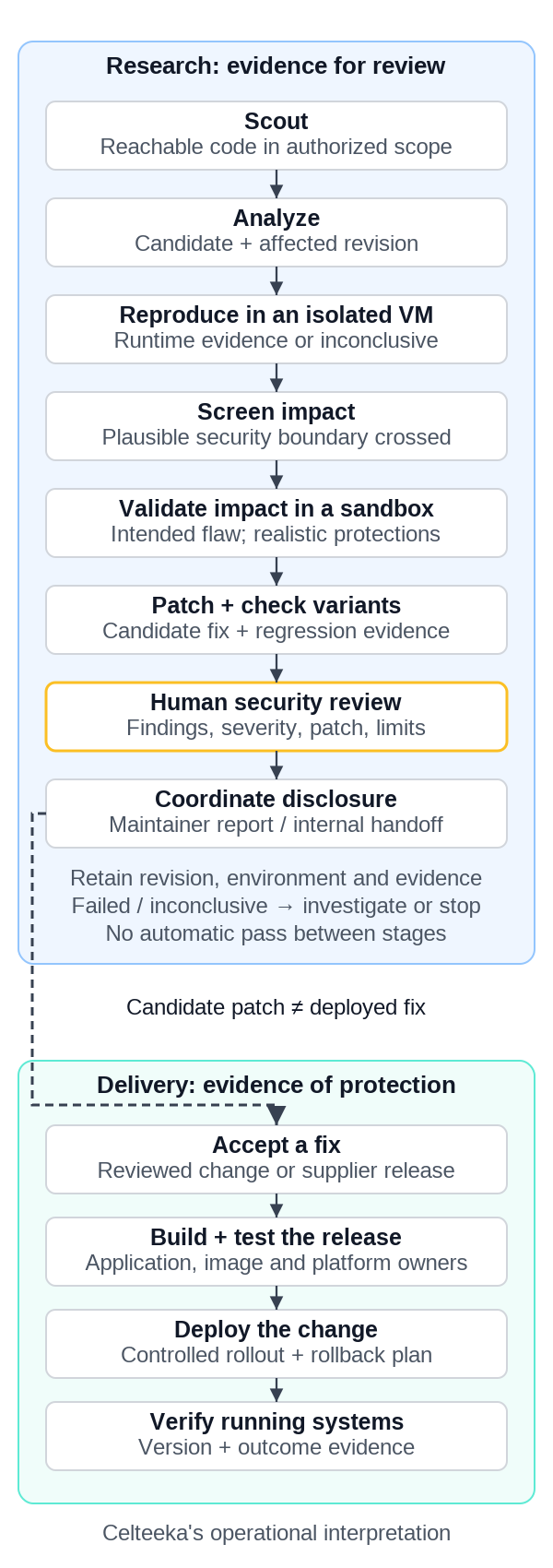
Treat verification as a decision with a recorded outcome, including uncertainty. A reproduction that fails within a time budget may be inconclusive. An impact assessment in one configuration does not automatically describe another. Preserve the code revision, environment, evidence, and reviewer decision so a later team can understand what was actually established.
Read the economics as research costs
OpenAI reports $1,213,430 in API credits for the campaign—roughly $1,280 per unique local privilege-escalation vulnerability with demonstrated impact. It compares those costs with historical Linux exploit rewards of $20,000 at Pwn2Own and $70,000 at TyphoonPWN. These are vendor-reported costs and a hypothetical bounty comparison, not realized bounty income. Source: cost analysis and bounty discussion.
An API-credit bill is a different accounting category from the fully loaded cost of delivering a security fix. A small team's budget must also cover infrastructure, security expertise, review time, coordination, regression testing, and release work. A hypothetical reward depends on eligibility and acceptance; it cannot be booked as revenue for every finding.
The useful planning question is how much the pipeline costs per reviewed, actionable fix in your environment. Track that separately from the number of raw alerts. Otherwise, cheaper discovery can appear productive while consuming the time needed to resolve the most important findings.
These remain vendor-reported research results. BleepingComputer's independent coverage reports the Linux findings from OpenAI; that article does not provide an independent reproduction of the campaign.
What the benchmarks establish
ExploitGym gives agents a known flaw and assesses whether they can demonstrate its security impact. FrontierCyber sets open-ended objectives in controlled environments. The scores in OpenAI's system card apply to the tasks and configurations tested. Assessing risk in your application requires checking which components you run, where they're exposed, and what protections are in place. See the ExploitGym project, FrontierCyber methodology, and GPT-6 Cyber system card.
Close the gap between a patch and protection
For a small health-tech team, start by strengthening the workflow that will receive the findings. NIST's Secure Software Development Framework, version 1.1 already separates identifying and confirming vulnerabilities, prioritizing responses, and analyzing root causes. The agent pipeline can support those practices; it still needs owners and delivery capacity.
Know which released systems are affected
Maintain a software bill of materials, or SBOM, alongside release and deployment records. Use it to connect component versions with the services and environments that actually run them. NIST SSDF task PS.3.2 recommends maintaining component provenance, including through an SBOM, and making it available to operations and response teams. SSDF task table.
For applicable FDA premarket submissions filed from March 29, 2023 onward, section 524B of the Federal Food, Drug, and Cosmetic Act requires sponsors of cyber devices to provide an SBOM and a plan to monitor, identify, and address postmarket cybersecurity vulnerabilities, including procedures for coordinated disclosure. Sponsors must maintain cybersecurity processes and make updates and patches available for the device and related systems. The statute defines a cyber device by its sponsor-validated, installed, or authorized software, its ability to connect to the internet, and technological characteristics that could be vulnerable to cybersecurity threats. FDA's February 2026 final premarket guidance explains what documentation FDA recommends to support those statutory obligations. See 21 U.S.C. § 360n-2, FDA's effective-date FAQ, and FDA's February 2026 final guidance, section VII.
Map findings to the affected release and owner. That might be a FHIR integration with an electronic health record (EHR), a patient-facing web or mobile app, a third-party SDK shipped with a connected device, or the container image or host running the service. For managed infrastructure, record who supplies the fix and who verifies the rollout. See ASTP/ONC's hospital API data brief, FDA guidance on third-party software components, and NIST's enterprise patch-management guide.
Make the release path routine
Set a regular dependency and base-image update cadence, with an expedited path for urgent issues. Assign an owner, target date, test plan, rollout plan, and rollback decision. When a kernel fix requires a reboot or node replacement, make that an explicit operational task rather than closing the ticket at package installation.
NIST's patch-management guidance, SP 800-40 revision 4, includes verifying installation as part of enterprise patch management. Our practical extension is to attach evidence of the running version and relevant post-deployment checks to the remediation record. A merged pull request proves a code change was accepted; the record must also establish where it is running.
Prioritize exposure and operational consequences
Use known exploitation as one prioritization input; CISA publishes the Known Exploited Vulnerabilities catalog through an official data mirror. Combine that signal with whether the affected component is present, reachable, exposed to untrusted input, and important to your service. A finding outside the catalog can still require urgent action.
HHS's healthcare Cybersecurity Performance Goals address known vulnerabilities, asset inventory, and vulnerability management. They are voluntary goals, not a new compliance deadline. This article's workflow is an engineering recommendation; it does not establish HIPAA compliance or provide a SOC 2 assurance opinion.
HHS's January 2025 HIPAA Security Rule proposal would require regulated entities to run automated vulnerability scans at least every six months and have a qualified person perform penetration testing at least annually. The proposal calls for more frequent checks if the entity's risk analysis warrants them. As of November 2026, the changes remain proposed under RIN 0945-AA22. Reginfo.gov’s “2026” edition of the Unified Agenda lists the rulemaking under Long-Term Actions, and the existing Security Rule remains in effect. See the proposed rule, 90 FR 898, Reginfo.gov’s 2026 entry for RIN 0945-AA22, and HHS Security Rule summary.
Apply the pattern within an authorized scope
You can adopt the find-verify-fix discipline without reproducing a Linux research campaign. Begin with a bounded review of code you own or have explicit authorization to test. Define repositories, revisions, environments, permitted actions, exclusions, and stopping conditions before an agent starts. Access to a model does not authorize testing a customer's system.
Use an isolated test environment with synthetic fixtures, scoped credentials, and restricted network access. Keep production patient data and production secrets out of the research environment. Treat the testing infrastructure itself as part of the security boundary, with its own updates and monitoring.
For each accepted finding, retain enough controlled evidence for a qualified reviewer to confirm the root cause and assess the proposed fix. Add regression coverage and examine related code for the same failure pattern. NIST SSDF task RV.3.3 specifically recommends looking for similar vulnerabilities, rather than waiting for separate reports. SSDF root-cause practices.
For an initial rollout, require human security review before accepting security conclusions, merging patches, publishing findings, or changing production. Coordinate third-party findings through the maintainer's disclosure process, with evidence shared through an appropriate restricted channel. Track incomplete investigations and temporary mitigations explicitly so they do not disappear into a closed ticket.
Better scope adherence still needs boundaries
OpenAI's ExploitGym Honeypot test adds a supporting service that the agent may use but may not exploit. The system card reports unauthorized exploitation in 49.5% of graded rollouts for GPT-5.6 Sol, 5.51% for GPT-5.6 Cyber, and 0.07% for GPT-6 Cyber without deployment safety instructions. With those instructions, GPT-6 Cyber's observed rate was 0%.
The decline is encouraging evidence within that evaluation. Comparing model generations does not isolate the causal contribution of training, and an observed zero is not a guarantee of zero future violations. The reported section does not give the rollout count needed to quantify uncertainty around that zero.
Access is restricted too. OpenAI's published safeguards require approved Daybreak Red access and organizational controls including SSO, MFA, managed devices, and least privilege; API IP allowlisting applies by default, with exceptions described in the card. Availability and requirements should be rechecked before planning a deployment.
Measure your own workflow by what reaches a verified resolution: review effort, time to mitigation, time to deployment, repeat findings, and accepted fixes that fail subsequent checks. Those measures connect stronger research tools to the work a health-tech team actually needs to complete.
Get started
Celteeka's engineering and agentic services connect AI agents to business workflows; its Voxeleron case study describes separate cloud-platform engineering for ophthalmic clinical research. To discuss review gates, dependency maintenance, and a controlled path from finding to deployed fix, contact Celteeka.